It’s time for every company in the world to build an internal software team. We have sales departments, finance departments, IT departments, marketing, operations, and now it is time for companies to add a new functional department – software. Software teams should no longer be relegated to technology companies – it is time for every company to embrace the abundance that writing custom software can unlock.
Today, the gap between the leverage that companies could be getting thru better use of AI technology and what they are actually achieving is massive. And that gap is growing every day. The key to unlocking that AI leverage is to start building custom software internally with software engineers who can unlock value immediately.

The Future of Software
Software has been in the news a lot recently, with publicly traded software companies getting trampled in the public markets as people question whether there will be a future need to buy software from anyone. While disruption is guaranteed, most software industry veterans, including myself, do not see a world where companies will vibe code all the software they need. There have been free open source versions of just about every major type of software you can think of for years. These open source software packages are free and maintained by global groups of developers (also free of charge). If companies weren’t adopting these products en masse before, then thinking they will want to make their own software in the future probably doesn’t quite consider what someone is buying when they buy standard SaaS software (at least for core functions).
I think the future of software is likely to be grouped into 3 buckets:
1. Off the shelf software to cover the basic functions covered by much of SaaS today
2. Custom software written to handle the specialized needs of individual companies
3. Consumer grade, vibe coded software handling lower level tasks for office workers
The first bucket, off the shelf software, will persist because you are buying much more than just code when you pay a SaaS company money for their product. The support, the security, etc. that you are buying will still make sense to buy in most cases rather than to try to deal with all of the headaches yourself. If it isn’t core to your business, it won’t make sense to spend calories thinking about and building this stuff from scratch.
The third bucket, consumer grade software, is all of the opportunities that OpenAI, Anthropic, and others will unlock for the typical office worker. The ability to do things like taking data from a spreadsheet, analyzing it and putting it into a presentation for your weekly meeting is here today and the typical office worker will eventually master many use cases like this that massively improve their efficiency.
The second bucket, custom software, is the interesting one. It’s completely new. This is all the custom software that every company has a need for, but could never afford to write before because it was too expensive to build custom software. Only extremely large companies could justify the expense. Massive increases in developer productivity fundamentally change the calculus here, now making those projects viable – unlocking massive opportunity for every company in the world. That pesky task that operations has been unable to automate… done. The custom data integration that your sales team has always wanted to enable in their workflow… it’s live now. The repetitive finance tasks that are mission critical to your operation, but extremely time consuming… automated and error free now.
Every business has opportunities like these. These are problems that are likely to be beyond the scope of what a typical office worker can accomplish, but easy for an AI enabled software engineer to execute. Custom software to do whatever your company needs, written in days and weeks, rather than months and years.
Starting in 2009, Dominos pizza CEO Patrick Doyle began a deliberate process of turning Dominos into a technology company that happened to sell pizza. They began building custom software for everything from ordering to delivery routing and store operations. Buoyed by the leverage the custom software enabled, Dominos stock famously increased about 50x from 2009 to 2024 – outperforming Amazon, Apple, Google, and Microsoft. This is the power of building custom software. But, when Dominos started the journey they already had the scale to be able to afford to build all of the custom software. Something most companies couldn’t afford to do. Now that opportunity is available to almost every company.
Who Is Going to Build this Custom Software?
This is where there is debate. Many people believe that because code is now easy to write, that this custom software will all be written by the users of the software and that software engineers will no longer be needed. I couldn’t disagree more. I think you’ll be far better off hiring a software engineer to write custom software, than you will be to expect other functional players in the organization to do so.
Generative AI is making elements of every white collar job easy to do without any expertise. Want to write some code? No problem. Want to write some marketing content? Also no problem. Want to craft and send some sales prospecting emails? AI has you covered. Need some help making a financial forecast from sales and operations data? AI can probably do it better than any human on your team. Software is not unique in terms of AIs ability to do useful work previously done by humans.
However, to the extent that we want a human in the loop at all (something that is likely critical to maintaining a competitive advantage in a world where everyone has access to the same AI models), functional expertise across an organization will still be a valued skill. Software engineering is no different than any other function. If you want to check the code, debug the code when something goes wrong, optimize the code for your purposes, etc. a software engineer is still going to have a massive advantage over another person who doesn’t know anything about how the underlying technology works.
Larger companies will probably build internal software teams that eventually look like the product teams that exist in tech companies that build software as their core product. They won’t just have engineers, they’ll also have product managers and designers. But for smaller companies, or companies just getting started, hiring a software engineer is likely your first choice as a critical enabler. And, just like with IT, some companies may choose to outsource the software department entirely, but they will still have someone writing custom software for them.
Going back to the 3 types of software I see in a future world, I do think there is still a whole category of software that will be written by people outside traditional software engineering roles. But, this software will be simpler and more task oriented, rather than complex and product oriented. This is where the consumer grade AI tools and software will get utilized.
There will also be a lot of variability in how well typical white collar workers utilize AI tools to get their jobs done. Here again, a software department would help massively. Similar to how an IT department helps everyone in an organization make the best use of the technology tools at their disposal, a software team can help employees in other functional departments get the most out of AI tools. And if the needed software is too complex to be vibe coded, the engineer can simply step in to write the custom software.
People are Already Starting to Build Internal Software Teams
One area where the trend I outline above is already starting to show up is in Go To Market (GTM) teams. GTM leaders are recognizing the capability of generative AI to dramatically improve their productivity, while simultaneously realizing the limitations of their ability to execute. Enter the role of the “GTM Engineer”.
A GTM Engineer is someone who codes custom software for revenue teams that helps teams connect systems, execute custom processes, and augment existing software to get the most leverage out of AI. It is an internal software engineer, just dedicated to the GTM team instead of being cross-functional (because the GTM team identified the need first). As other functional areas of the organization realize similar opportunities I expect to see many more functional specific engineering job postings. Eventually, companies will realize these people should probably live in a dedicated software department rather than in disconnected silos throughout the organization.
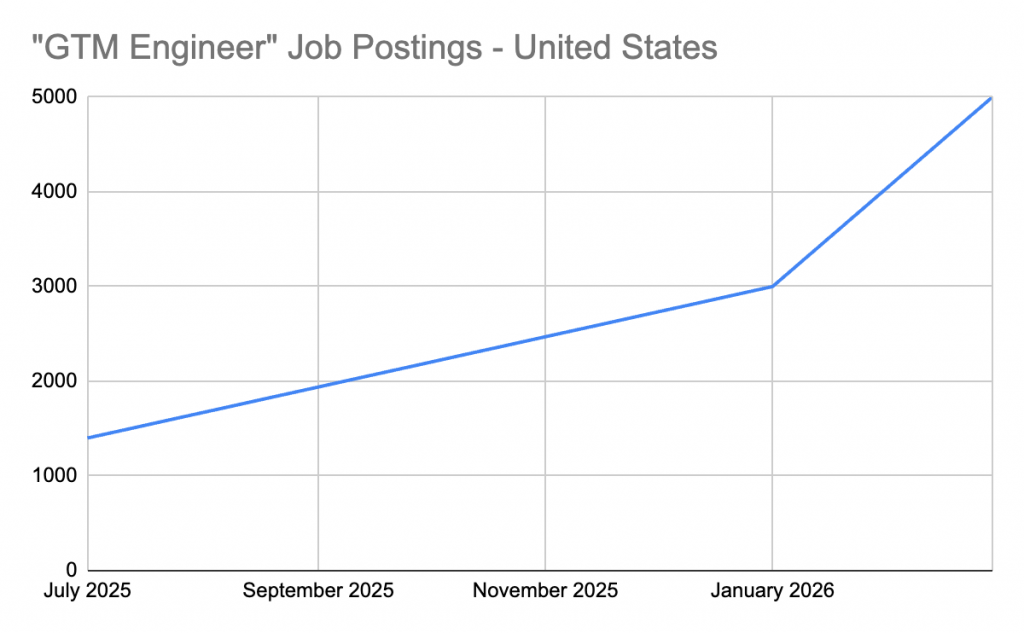
In July of 2025 there were 1,400 open jobs in LinkedIn in the US for “GTM Engineers”. By January of 2026 that was up to 3,000. By March there were over 5,000. The demand curve is going vertical.
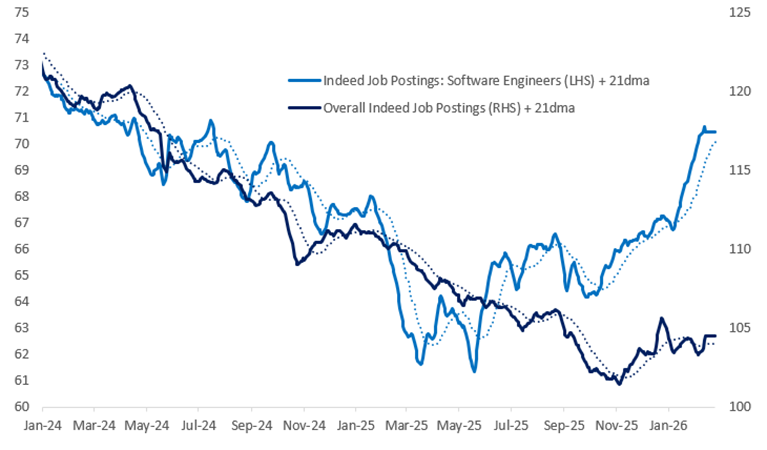
In fact, despite the massive gains in productivity for software engineers, demand for software engineers has started to increase faster than the baseline hiring for all types of workers. Being able to do more with less is creating more demand for engineers, not less.
Software Engineering Demand is Going to Go Thru the Roof
Today, the world is preoccupied with doom and gloom scenarios about a potential cratering of demand for software engineers. People are predicting mass layoffs among a shrinking global need for software engineers. If you believe this article then the exact opposite is about to happen.
As the demand for software engineers goes from being just among tech companies to including every single company in the world, demand for software engineers is going to make previous supply shortages look tame by comparison.
There are approximately 1.9 million software engineers in the United States today. That represents just 2%-3% of the white collar workforce in the US. We still need these people to build the mass market software that has been the bread and butter of the software industry to date. But, as the need to build custom software spreads to all types of companies we will not have nearly enough engineers.
By comparison, there are approximately 2.3 million people who work in IT departments in the United States. I think it is pretty easy to imagine a scenario where we need at least as many software engineers in companies – that would more than double the demand for software engineers in the United States. And in a world where the leverage of a highly functioning software department is immense, I think there is good reason to believe we will need even more.
The Greatest AI Accelerant Available in the World Today
Everyone inside of companies is under immense pressure to get more out of AI today. Boards are pressuring CEOs, CEOs are pressuring executive teams, and individual contributors are being given tools and asked to do more with less. But, the pace of adoption has been slow. Public companies are only incrementally showing marginal gains in productivity. The opportunity gap is widening.
What is the number one thing you can do today to take advantage of AI in your company? Hire a software engineer.
The only thing you’ll ever question is why it took you so long in the first place.
0 Comments